How many observations do we need to characterise an individual?
A method and an open tool for deciding how many measurements of one person a time series study needs. Master’s thesis in psychology, KU Leuven, 2020.
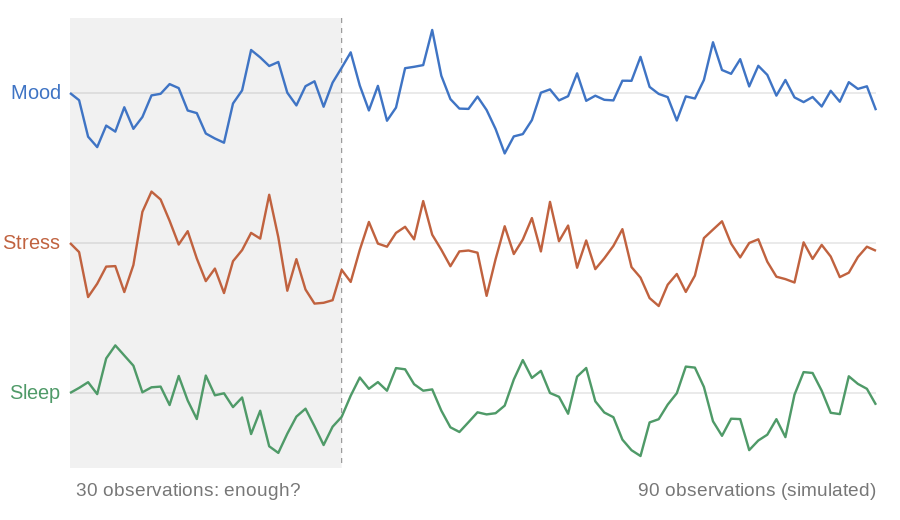
The question
Psychologists increasingly follow one person over time: how mood, stress and sleep rise and fall, and how each affects the others. The usual model for this, vector autoregression (VAR), estimates how every variable depends on every other variable at the previous moment. That is a lot of relationships to estimate, and with too few measurements the model fits noise.
Nobody could say how many measurements were enough.
The method
Compare the VAR model with a simpler one, autoregression (AR), which only relates each variable to its own past. With little data the simple model predicts new data better. With enough data the richer model wins. The number of measurements where VAR starts to win is the number a study needs.
To find that point, the method simulates datasets of different lengths from a model the researcher describes, fits both models to each, and scores them on stretches of data they have not seen. The scoring uses blocked cross-validation, which keeps the order of time intact.
The tool
tsim is an R application with a point-and-click interface, so a researcher can plan a study without writing code. The model’s starting values can come from data collected earlier.
Why it still matters
The question did not stay in psychology. It came back as how many days of camera footage a junction needs, and it is now the question for AI: how many observations does it take to characterise an AI system?